LabApprentice:
Self-Improving Wet-Lab Robotics Harness
LabApprentice explores how a coding agent can accumulate practical tools through physical experiments. Programs written for pouring, heating and instrument control become available to later runs.
Explore the experimentsExperiments
05 tasks / 18 recorded runsBringing the tools together
A hydrogel experiment using accumulated tools
Make a PEDOT:PSS hydrogel in two molds and measure each gel with the potentiostat, starting with the store from Pour, Heat, Split and Calibrate.
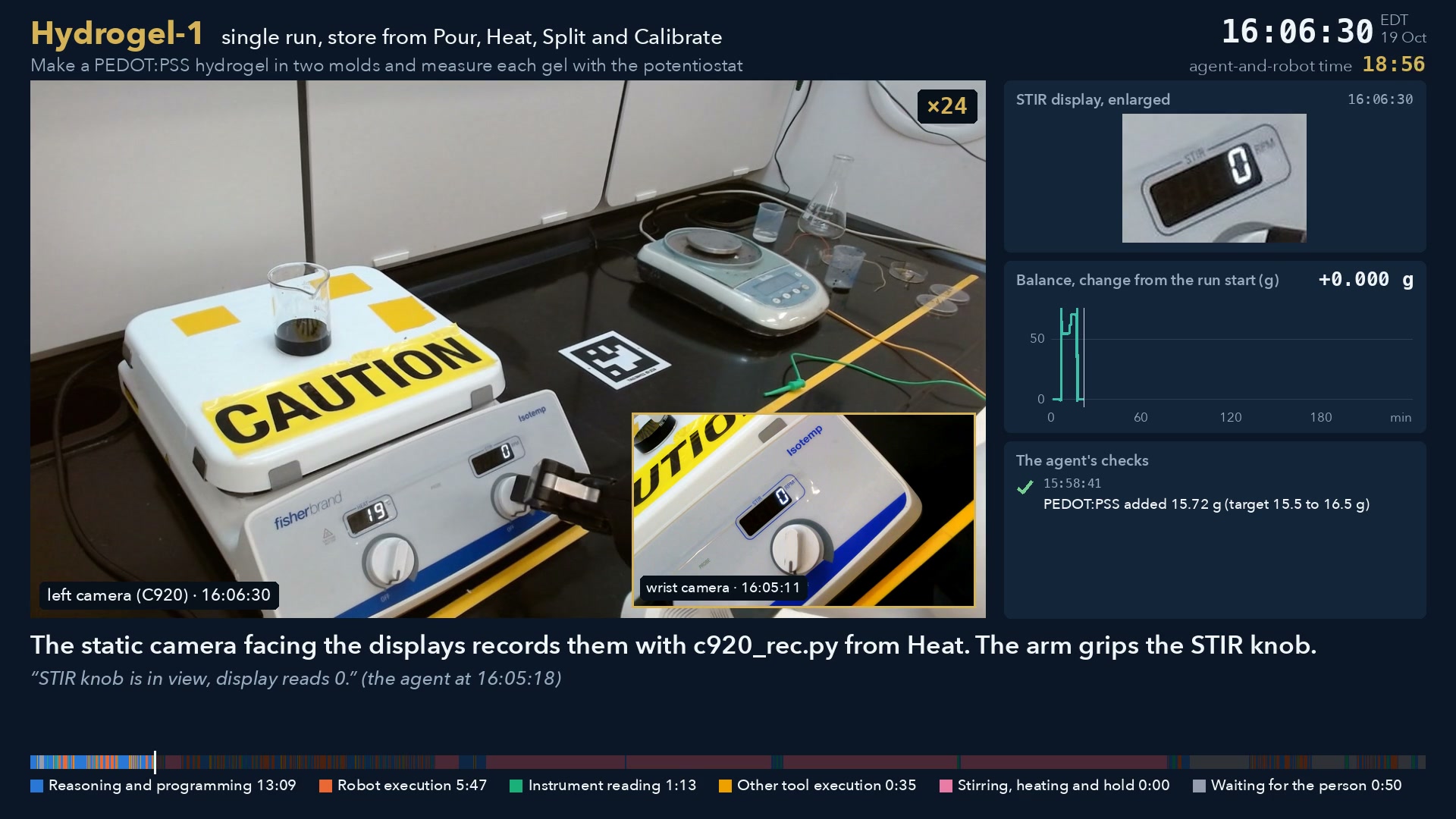
Hydrogel-1 combines the earlier tasks in one workflow.
Loading video…
MOMENTS TO WATCH
The arm turns the STIR knob with the program from Heat.
A lid missing from mold 2 is found on the bench and placed again.
The potentiostat measures the gel with the program from Calibrate.
In these runsHydrogel-1 reuses the knob program from Heat and the potentiostat program from Calibrate. During the run, a missing lid is found on the bench and placed again.
Keeping the programs
From one run to the nextEach run begins in a fresh agent session with a written procedure and run-specific parameters. The agent reads a persistent skill store, then reuses or writes programs to carry out the experiment. The store holds tools, written skills, notes, and dated bench positions and calibrations.
The starting harness supplies basic motion, perception and instrument tools. During a run, the agent adds missing capabilities to the store. The store is copied before and after each run; people also correct stored facts between runs, and the agent can record their answers.
- 01 / READ
Procedure and prior tools
A new session reads the task, its parameters and the store’s notes before acting.
- 02 / EXECUTE
Code meets the bench
Reused or newly written programs operate the instruments. Every arm motion passes through a server with fixed motion checks.
- 03 / VERIFY
Claim, then check
For each evaluated step, the agent records its belief before reading the instrument, then logs the reading and verdict against the criterion.
- 04 / KEEP
Pass on usable artifacts
Programs, instructions and practical observations stay in the store for the next session.
Checks come from the instruments
The balance reports mass over RS-232. Cameras read the hot plate’s displays and record spills. The potentiostat measures impedance through its vendor toolkit. The arm turns the hot plate’s physical knobs.
Supervised physical experiments
A person holds the emergency stop and responds to logged requests, including vessel exchanges and cable changes. People label the criteria from the records after each run. The harness’s programs and skills remain fixed within each task.
Pour
Mass-targeted pouring
pour_target.pyHeat
Turning instrument knobs
Knob programSplit
Grasp and pour corrections
Stop 0.8 g earlyCalibrate
Potentiostat control
Instrument programTools reused in Hydrogel-1
Heat → STIR-knob control. Calibrate → potentiostat measurement.
A COMPARISON WITH AN EMPTY STORE
What happens when the saved tools are absent?
Runs ending in -C repeat the task’s second variant with a fresh, empty store, after the runs using the accumulated store. The harness, procedure, person and bench are held the same. Across the repeated runs, targets, vessel orientations or instrument positions change.
- Pour-CWrites the pouring program again.
- Heat-CWorks out a tilted grasp from scratch.
- Split-CA beaker slip is visible in the camera frames.
- Calibrate-CDeforms a mold without the stored grip rule.
Measurements
Recorded experiments · October 2026Agent-and-robot time combines reasoning and programming with robot execution. Instrument readings, procedure waits and waits for the person are accounted for separately.
Pour
59% less time, first to lastHeat
22% less time, first to lastSplit
54% less time, first to lastCalibrate
24% less time, first to lastEach bar is one run. Targets, positions or vessel orientations changed between runs; each control repeats the second variant with an empty store. The Calibrate control was stopped after a mold cracked.
Hydrogel-1
The combined workflow ran 13 of the 14 stored tools from the earlier tasks. All 8 evaluation criteria were met in this run.
After curing at 60 °C for 2 hours, the potentiostat measured the two gels. Conductivity was estimated from resistance and each mold’s calibrated cell constant.
| Mold | Dispensed mass (g) | Resistance (Ω) | Conductivity (S/m) |
|---|---|---|---|
| 1 | 5.26 | 142.3 | 0.71 |
| 2 | 5.62 | 115.8 | 1.12 |
Data from the LabApprentice manuscript.
Scope of this study
These are preliminary wet-lab experiments. The Hydrogel demonstration consists of one recorded run. The examples document specific instances of program reuse and physical execution; broader reliability and generalization require further evaluation.
Reading the recordings
Pour, Split and Calibrate use snapshots taken at the agent’s steps. Heat and Hydrogel also include timelapse footage. On-screen checks, instrument readings and end cards provide context for each run.
Film timestamps refer to the edited videos. Agent-and-robot time combines reasoning and programming with robot execution. Instrument time, procedure waits and human waits are accounted for separately. The recordings also show a wall-clock counter.